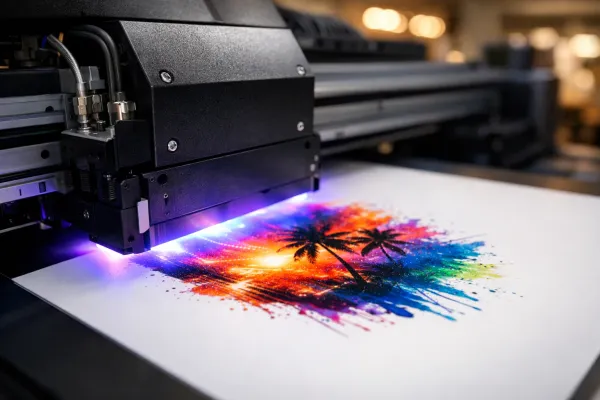
UV Printing Explained: How We Print on 300+ Different Surfaces
March 28, 2026 · By Fantasy Print Studio
UV printing is a modern printing technology that uses ultraviolet light to instantly cure (dry) ink as it's applied to a surface. Unlike traditional printing methods that rely on heat or pressure, UV printing bonds ink directly to the material at a molecular level — producing vibrant, scratch-resistant prints on virtually any surface. It's the technology behind every product we create at Fantasy Print Studio.
How UV Printing Works: The Science Made Simple
The UV printing process involves three key steps. First, a specialized printer deposits UV-curable ink onto the surface in precise droplets — as small as 3.5 picoliters, according to printing industry standards from the Specialty Graphic Imaging Association (SGIA). Second, UV LED lamps immediately expose the ink to ultraviolet light. Third, this UV exposure triggers a photochemical reaction called polymerization, which instantly hardens the ink into a solid, durable layer.
This instant curing is what makes UV printing so versatile. Because the ink doesn't need to be absorbed by the material (like inkjet on paper) or transferred via heat (like sublimation), it works on surfaces that other printing methods simply can't handle.
UV Printing vs. Other Printing Methods
Understanding the differences helps you see why UV printing delivers superior results for custom products:
Sublimation printing uses heat to transfer dye into polyester-coated surfaces. It produces good color but only works on white or light-colored poly-coated materials. UV printing works on any color surface, including dark and transparent materials.
Heat transfer vinyl (HTV) applies a vinyl layer using heat and pressure. It creates a raised texture and can crack or peel over time. UV prints sit flat on the surface and won't peel because the ink is chemically bonded to the material.
Screen printing pushes ink through a mesh screen — great for high-volume apparel, but impractical for single custom items on hard surfaces. UV printing is ideal for one-off custom orders with no setup costs.
What Surfaces Can UV Printing Handle?
This is where UV printing truly shines. At Fantasy Print Studio, we print on over 300 surfaces across these material categories:
Plastics and polymers: phone cases, AirPod cases, laptop covers, and tablet stands. Metals: aluminum panels, stainless steel tumblers, and custom signs. Glass and ceramics: mugs, ornaments, tiles, and coasters. Wood: cutting boards, plaques, picture frames, and decorative panels. Acrylic: keychains, desk signs, and display pieces. Leather and faux leather: wallets, journal covers, and bookmarks.
The Durability Advantage
UV-cured inks are remarkably durable. Industry testing by the International Organization for Standardization (ISO 11798) shows that UV prints resist scratching, fading from UV exposure, and chemical contact significantly better than conventional inks. For everyday products like phone cases and tumblers, this means prints that maintain their vibrancy through daily use, washing, and sun exposure.
Why We Chose UV Printing for Our Family Studio
When we started Fantasy Print Studio, we evaluated every printing method available. UV printing won because it lets us say yes to almost any custom request. A customer wants their dog's face on a wooden cutting board? Done. A wedding photo on a glass panel? Done. A company logo on 50 metal tumblers? Done. No special coatings, no material limitations, no compromises on quality.
That versatility is why we can offer printing on 300+ surfaces — and why every product we make comes out vibrant, durable, and exactly the way you imagined it.
Frequently Asked Questions
Is UV printing safe for items that touch food or drinks?
UV-cured inks, once fully polymerized, are considered safe for exterior surfaces of drinkware like tumblers and mugs. We print on the outside surface of all food-contact items, never on surfaces that directly touch food or beverages.
What image quality do I need for a good UV print?
For best results, we recommend images at 300 DPI (dots per inch) or higher. Standard smartphone photos typically work well for most products. We'll always check your image quality before printing and let you know if a higher resolution version would produce better results.